StereoComplex
Robust ChArUco calibration and ray-based stereo reconstruction
StereoComplex is a lightweight Python toolkit for robust stereo calibration, Ray2D ChArUco refinement, ray-based 3D reconstruction, and non-central optical model diagnostics.
If you already know OpenCV calibration, start with the onboarding notebook:
examples/notebooks/00_getting_started.ipynb
It shows the shortest path: define a ChArUco board, compare raw OpenCV against Ray2D-refined calibration, assess calibration quality, and export back to OpenCV format.
Video 1 (overview)
What StereoComplex does
Layer |
Meaning |
Status |
|---|---|---|
Ray2D / planar ray-field |
Homography plus smooth residual field on the calibration board plane |
stable practical preprocessing |
Central 3D ray-field |
Pixel → 3D direction with a shared camera center |
research prototype |
Non-central 3D rayfield |
Pixel → 3D line |
research-grade, validated on synthetic oracles and one real CMO case study |
The 2D Ray2D refinement is not itself a 3D non-central camera model. It improves the image observations fed to calibration. The non-central backend is a separate 3D line-based model.
Engineering footprint: no ROS, no Docker requirement, no C++ toolchain; the core is a Python package using standard scientific libraries.
Recommended path
First use / OpenCV migration → From OpenCV to StereoComplex and
examples/notebooks/00_getting_started.ipynb.Fix ChArUco / OpenCV calibration → Fix my calibration (OpenCV + ChArUco), Bring your own data, and
examples/notebooks/01_ray2d_vs_opencv.ipynb.Ray-based 3D reconstruction → 3D ray-field (central) and ray-based calibration and
examples/notebooks/02_ray3d.ipynb.Non-central calibration → Non-central stereo calibration from image folders and
examples/notebooks/04_parallel_plate_origin_field.ipynb.Optics identification / CMO case study → Real CMO microscope calibration on Pycaso data, Physical CMO Model, and
examples/notebooks/09_pycaso_real_data.ipynb.
Key contributions
Robust ChArUco refinement without requiring a camera model. Ray2D /
rayfield_tps_robustuses a homography plus a smooth residual field on the board plane.OpenCV-compatible stereo calibration diagnostics. StereoComplex compares raw and refined ChArUco points and reports stereo/reconstruction metrics.
Central 3D ray-field reconstruction. The central backend learns a compact pixel-to-ray direction model and triangulates from rays.
Non-central Zernike rayfield calibration. Each pixel can define a 3D line instead of sharing one optical center.
Ray-space optical model identification. A measured Zernike rayfield can be used to compare compact physical hypotheses such as Brown-Conrady, inclined plate, CMO-like, and generic fallback rayfields.
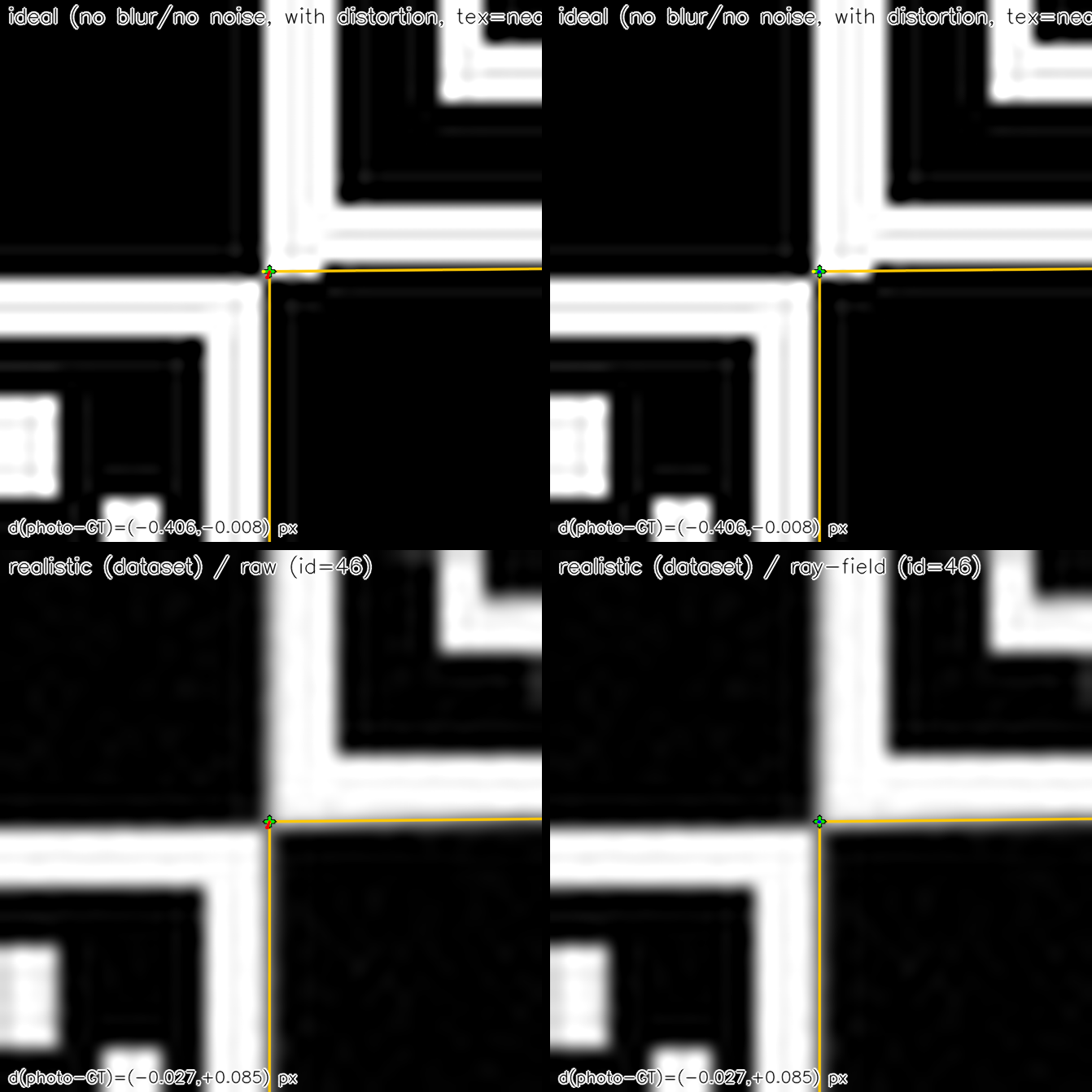
Fig. 1 Same GT (with geometric distortion) on a strict ideal render (top: no blur/no noise, nearest texture sampling) vs realistic (bottom), raw vs ray-field.
Key result: non-central rendered-image benchmark
On the inclined-plate benchmark, raw OpenCV ChArUco detections impose a high reconstruction floor. With Ray2D-refined observations, the same non-central bundle adjustment reaches sub-millimetric reconstruction accuracy:
OpenCV raw: central RMS ≈ 4.21 mm, oracle-detected RMS ≈ 3.44 mm, non-central BA RMS ≈ 3.36 mm.
Ray2D refined: central RMS ≈ 2.50 mm, oracle-detected RMS ≈ 0.76 mm, non-central BA RMS ≈ 0.66 mm.
Interpretation: the non-central model works when the 2D observations are good enough; front-end quality is the limiting factor on rendered or real images.
Key result: real CMO microscope data
The Pycaso CMO microscope case study is the main real-data validation of the non-central workflow. It separates a flexible measured rayfield from a compact physical interpretation:
Model / method |
Role |
RMS |
|---|---|---|
Standard OpenCV stereo on the tested setup |
central baseline |
>300 px |
Perspective CMO physical model |
wrong optical family |
~86 px |
Telecentric CMO 14p |
correct family but not usable |
~14.6 px |
Telecentric CMO + per-arm SE(3), 26p |
compact usable physical model |
1.06 px |
Zernike O(0)+d(2), 57p |
flexible rayfield reference |
0.47 px |
The key methodological point is that the rayfield is not only a calibration model; it is also a diagnostic instrument used to build and falsify compact physical optical models.
See Real CMO microscope calibration on Pycaso data, Physical CMO Model, and
examples/notebooks/09_pycaso_real_data.ipynb.
Notebook walkthroughs
If you want a guided, visual introduction before reading the code or the advanced case studies, start with the notebook series:
``00_getting_started.ipynb``: first OpenCV-to-StereoComplex onboarding.
01_ray2d_vs_opencv.ipynb: raw OpenCV detections vs Ray2D refinement.02_ray3d.ipynb: compact central 3D ray-field and compression sweeps.03_rayfield_virtual_rectification.ipynb: virtual rectification maps for dense stereo.04_parallel_plate_origin_field.ipynb: inclined-plate non-central oracle.05_noncentral_calibration_from_images.ipynb: practical non-central image-folder workflow.06_cmo_model_selection.ipynb: CMO-like rayfield measurement and model selection.09_pycaso_real_data.ipynb: real Pycaso CMO microscope case study.
Companion .py exports are stored next to the notebooks for quick inspection
in any text editor. See Notebook walkthroughs for the complete sequence, including
scripts 07 and 08.
Quickstart from OpenCV
from pathlib import Path
import stereocomplex as sc

board = sc.CharucoBoardSpec(
    squares_x=11,
    squares_y=7,
    square_size_mm=39.07,
    marker_size_mm=27.35,
    aruco_dictionary="DICT_4X4_1000",
)

report = sc.compare_opencv_stereo_calibration(
    left_dir=Path("my_data/left"),
    right_dir=Path("my_data/right"),
    board=board,
)

assessment = sc.assess_calibration(report["refined_result"])
K1, d1, K2, d2, R, T = report["refined_result"].to_opencv()
Documentation map
Getting started: Start Here, Tutorial: From zero to CMO calibration in 15 minutes, From OpenCV to StereoComplex, Bring your own data, Fix my calibration (OpenCV + ChArUco), Notebook walkthroughs.
ChArUco and 2D refinement: ChArUco: 2D identification strategy (baseline), Worked example: raw OpenCV ChArUco vs a ray-field second pass (errors + plots).
Ray-based calibration and reconstruction: Stereo 3D reconstruction (OpenCV) and the impact of the ray-field, Reconstruction API (load model, triangulate points, optional image maps), 3D ray-field (central) and ray-based calibration, Virtual rectification for dense stereo.
Non-central and optical models: Non-central stereo calibration from image folders, Identify My Optics, Optical model selection — CMO workflow and classification matrix, Rayfield mediation: separating measurement from optical interpretation, Cahier des charges — Direct vs Rayfield-mediated inversion, Inclined parallel-plate oracle and Zernike origin-field identification.
Real-data CMO case study: Real CMO microscope calibration on Pycaso data, Physical CMO Model, Pycaso-style depth sweep vs 3D ray-field.
Validation and benchmarks: Validation status, Image compression and 3D reconstruction, Robustness sweep (board size, focal length, aberrations), Roadmap — StereoComplex user-facing API.
Reference: API reference, Public API contract, Release readiness — v0.1.0-alpha, Architecture, Conventions, Dataset specification (v0), Alternatives and positioning, Documentation license (CC BY-SA 4.0).